


Household Hazardous
Waste Flyer
Cuba Cemetery
 |
Cemetery Map Current List of Interments |
In the early
nineteenth century, Cuba was a growing community, serving as a stopping
point where pioneers heading west on the Alleghany River could spend the
winter and stock up on supplies before making their journey in spring.
Construction of the Erie Railroad and
Genesee Valley Canal in the 1830s-1850s improved Cuba’s prospects by
linking it to more distant markets.
Early burials in Cuba
occurred on residents’ farms or in neighborhood burial lots.
By 1841, many residents believed the
community needed a common burial ground.
A public meeting that September
resulted in formation of the Cuba Cemetery Association and appointment
of a committee to identify and acquire a site.
A few days later, the committee
reported that Mr. Lewis Nash was willing to sell a two-acre plot behind
his house for $300.
After reaching an agreement with Mr.
Nash to purchase his land, the trustees began organizing the laying out
of burial plots and roads, and interments in the new cemetery soon
began.
Despite this
auspicious beginning, the Association struggled to collect money from
lot purchasers and did not pay their debt to Mr. Nash on time.
After concerned citizens mounted
short-lived efforts to revive the Association in 1850 and 1869, the
state government intervened in 1898, legally re-forming the Cuba
Cemetery Association with a new board of trustees.
This time, the director’s instituted
better fiscal management, including an assessment on lot owners to pay
for general maintenance of common areas and unoccupied lots; this
finally led to consistent upkeep and beautification of the grounds.
By 1902, the efforts
of the revitalized Cuba Cemetery Association were paying off.
An article in the
Cuba Patriot & Free Press noted:
Three years of time,
much hard work and inconsiderable amount of money has worked wonders in
Cuba’s silent city. This long neglected resting place of our dead, has
in three short seasons by the untiring efforts of the officers and
directors of the Cuba Cemetery Association, assisted by many public
spirited citizens, been transformed from an eyesore to all who visited
it, into a beautiful spot, where we can in some measure of comfort
consign the bodies of our loved ones to their last long sleep.
It were a sin that this peaceful
village on the hillside was so long allowed to remain a tangle of wild
plants and vines, but all is changed now and velvety green grass now
flourishes where weeds and vines formerly grew unmolested.
Carefully graded lots, paths and
drives, and well trimmed shrubs and trees, made the Cuba Cemetery of the
present a place of beauty for the living, and a fitting resting place
for the dead.
(“Cuba Cemetery,”
Cuba Patriot, 27 March 1902.)
In 1855, a Roman
Catholic cemetery was consecrated in Cuba, on a half acre of land
immediately to the east of the existing Cuba Cemetery.
Cuba’s Catholic population at the time
was overwhelmingly Irish, consisting of laborers who had come to the
area to work on railroad or Genesee Valley Canal construction.
It was important for the Catholic
community to have its own cemetery because of devout Catholics’ need to
be buried in consecrated ground; establishment of separate Protestant
and Catholic cemeteries was common in communities with both Protestant
and Catholic residents.
By 1898, the Catholic
cemetery had expanded to the south, into roughly a trapezoidal shape.
In 1923, Cuba Cemetery and the
adjacent Catholic cemetery merged.
Today the two are fully integrated,
with no fence or border distinguishing between the two; only the
prevalence of Irish names indicates the location of the former Catholic
section.
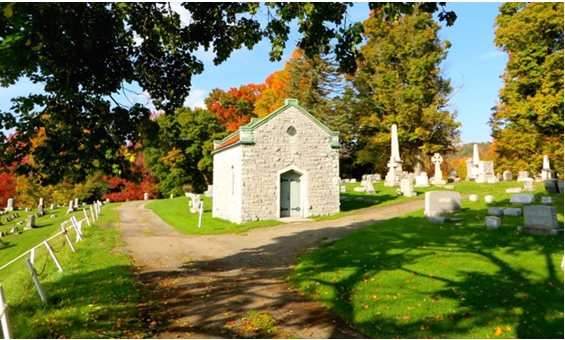
Cuba Cemetery has
long been admired for its beautiful, peaceful setting.
It is an excellent example of the
mid-nineteenth century
rural cemetery style.
Based on contemporary English
cemetery and landscape design, the American rural cemetery movement was
inspired by romantic perceptions of nature, art, national identity, and
the melancholy theme of death.
Rural cemeteries were typically
located on hilly sites at the outskirts of cities and villages, both due
to concerns about sanitation and disease and to foster the sense of a
special place, apart from the ordinary world, set aside for
contemplating and honoring the memory of the dead.
Rural cemetery landscapes are
characterized by curving forms, irregular massing of plant materials,
and asymmetry rather than a formal, regularized layout.
While meant to look like the work of
nature, in reality rural cemeteries were carefully designed and usually
required extensive earth moving as well as thinning and replanting of
trees.
Cuba Cemetery is the
final resting place of many of Cuba’s most notable citizens, including
many members of the first families to settle in Cuba, business leaders,
veterans of wars dating back to the War of 1812, politicians,
abolitionists, and philanthropists.
Also buried here are farmers,
laborers, shopkeepers, homemakers, and other typical citizens who made
their homes in Cuba.
The cemetery has
grown many times over since its origins on Mr. Nash’s two-acre plot.
Additional land was purchased in 1854,
1869, 1898, 1899, 1957, and 1981, bringing the cemetery to its present
size of 11.9 acres, including the Catholic cemetery added in 1923.
Newer sections are distinguished by
their flatter topography and more modern monuments; Section E is
developed in the twentieth-century memorial park style, with markers
flush with the ground to give the appearance of unbroken lawn.
In 2014, Cuba
Cemetery was nominated to the State and National Registers of Historic
Places, in recognition of its historical importance to the town and
village of Cuba and its notable design.
Still run by the Cuba Cemetery
Association, it remains a peaceful place of contemplation and scenic
beauty.
The cemetery is located on Medbury
Avenue, on the northeast outskirts of the village of Cuba.

Cuba Police Department
585.968.1666
DIAL 911 for EMERGENCY
Cuba Fire Department
585.968.2530
www.cubasmokeeaters.com
Volunteer Ambulance
585.968.1666
National Grid Electric
800.892.2345
National Fuel Gas
800.444.3130
Cuba Water & Sewer
585.968.2487
(bar)